
Nobody tells you about the fear that hits in the taxi to the airport. You’ve read the blogs, packed and repacked the bag, and somewhere over the Atlantic (or the Bay of Bengal, or wherever your route begins) a small voice asks what on earth you think you’re doing.
That voice is normal. Every backpacker has heard it. It goes quiet about two days in, usually somewhere between your first hostel breakfast and the moment a stranger from Munich invites you to share a taxi to a waterfall.
This guide covers what the packing lists leave out: what a first trip actually costs per day, what to sort out in the eight weeks before you fly, what to do in your first 48 hours on the ground, and the three scams that find every new backpacker eventually. Practical stuff first, mindset stuff after.
How long should your first backpacking trip be?
Two to four weeks. That’s the honest answer, and it’s shorter than most first-timers want to hear.
A fortnight is long enough to settle into the rhythm of the road, get comfortably lost, recover from your first bout of dodgy stomach, and figure out whether this style of travel suits you. It’s short enough that a mistake stays a funny story rather than a financial crisis.
Plenty of people book a six-month odyssey as their first trip and love every minute. Plenty of others burn out by week five, having spent a fortune on a route they’d planned before they knew what they actually enjoyed. Do a shorter loop first. If you come home already plotting the next one, congratulations, you’re a backpacker now, and your second trip can be as long as your savings allow.
Where should you go first?
Three regions do most of the heavy lifting for first-timers, and they earn it.
Southeast Asia remains the classic starting point. Thailand and Vietnam have hosted backpackers for four decades, which means cheap dorms everywhere, easy transport between towns, street food that costs less than a coffee at home, and thousands of other travellers to learn from. When something goes wrong, someone within ten metres has already solved that exact problem.
Central Europe and the Balkans suit anyone nervous about a big culture leap. Trains and buses connect everything, English gets you far, and countries like Poland, Hungary, Albania and Bosnia cost a fraction of what Paris or Amsterdam will drain from your card.
Central America offers the middle path: proper adventure, Spanish practice, volcanoes and reefs, on a well-worn route from Mexico down through Guatemala, Nicaragua and Costa Rica.
Pick the one that excites you rather than the one that scares you. There will be time for the scary ones later.
What a first backpacking trip actually costs per day
Here’s the section most guides dodge, so let’s put rough numbers on the table. These are realistic 2026 daily ranges for a budget traveller sleeping in dorms, eating local food, and taking one paid activity every few days. Prices move, so treat them as planning figures and check current hostel and transport costs for your specific route before you commit.
- Southeast Asia: roughly $30 to $50 per day. Vietnam and Laos sit at the bottom of that range, Thailand’s islands and Singapore push well past the top of it.
- Central America: roughly $35 to $55 per day. Guatemala and Nicaragua are kind to your wallet; Costa Rica and Belize are not.
- The Balkans and Eastern Europe: roughly $45 to $70 per day.
- Western Europe: $80 to $120+ per day, and that’s with supermarket dinners and free walking tours doing a lot of work.
Whatever you calculate for the trip, add a buffer of at least 20 per cent, then add a separate emergency fund you pretend doesn’t exist. The buffer is for the boat trip you didn’t plan and the night bus you bail on in favour of a flight. The emergency fund is for a lost passport or a hospital visit, and it comes home untouched on a good trip.
One more number: flights and insurance sit outside the daily budget. Price those separately so your daily figure stays honest.
Your 8-week countdown to departure
Backpacking prep isn’t complicated, but a few tasks have long lead times and they’re the ones that wreck trips when left late. Work backwards from your flight.
8 weeks out. Check your passport. Most countries refuse entry if it expires within six months of your arrival date, and renewals can take weeks. Research visa requirements for every country on your route, not just the first one. Book an appointment at a travel clinic, because some vaccination courses need multiple doses spread over a month or more.
6 weeks out. Buy travel insurance and actually read what it covers. Cheap policies often exclude the things backpackers do, like riding scooters or trekking above certain altitudes. Book your first flight and, if the country requires proof of onward travel, your exit too.
4 weeks out. Sort your money setup. Order a fee-free travel card (more on that below) because physical cards take time to arrive. Book your first two nights of accommodation. Just two. You’ll thank me later.
2 weeks out. Buy or borrow your backpack and start test-packing. Walk around with it loaded. Set up your phone: offline maps, translation app, an eSIM for your first country. Scan your passport, insurance documents and vaccination records, then email them to yourself and save offline copies.
Departure week. Tell your bank you’re travelling so a hostel charge in Hanoi doesn’t freeze your card. Get a small amount of cash for your first country. Share your rough route with someone at home and agree how often you’ll check in.
Choosing your backpack: the 40-litre question
Backpack size is the first real decision you’ll make, and the industry default of a 65-litre monster is wrong for most first-timers.
A 40 to 45-litre pack fits in most airline carry-on allowances, forces you to pack sensibly, and spares your spine. A 50 to 55-litre pack gives breathing room if you’re carrying gear for cold weather or plan to pick up souvenirs along the way. Almost nobody genuinely needs more than that for hostel-based travel, and the people lugging 70 litres up hostel staircases will tell you so themselves, wheezing.
Fit matters more than brand. Load the pack with 10 kilos in the shop and walk around for ten minutes. The weight should sit on your hips, not hang from your shoulders. A front-loading (clamshell) design beats a top-loader for city travel because you can reach anything without emptying the whole bag onto a dorm floor.
Pack half of what you think you need
Every experienced backpacker gives this advice. Every first-timer ignores it. Then, three weeks in, a hostel in Chiang Mai or Split inherits a pile of clothes that seemed essential at home.
Here’s a working capsule for warm-weather travel: five t-shirts, one long-sleeved layer, two pairs of shorts or light trousers, one pair of trousers decent enough for a temple or a border crossing, seven pairs of underwear, four pairs of socks, one rain jacket, one pair of walking shoes, one pair of sandals. Add a microfibre towel, a padlock for hostel lockers, a universal adapter and a basic first-aid kit with rehydration salts.
That’s it. Laundry costs a dollar or two almost everywhere backpackers go, and anything you forgot can be bought locally, usually cheaper. The only things genuinely hard to replace on the road are prescription medication, good walking shoes already broken in, and niche electronics.
Set up your phone before you fly
Your phone replaces the guidebook, the map, the phrasebook and the traveller’s cheques of previous generations, so give it an hour of setup at home.
Get an eSIM. Providers like Airalo, Holafly and Nomad let you buy a local or regional data plan before you land, so you walk out of arrivals already online. Compare prices per gigabyte for your route; regional plans often beat single-country ones if you’re crossing borders. If your phone doesn’t support eSIM, airport SIM counters still exist, but buy only what you need for a few days and find a cheaper shop in town.
Download offline maps. Google Maps lets you save entire regions; Organic Maps and Maps.me work fully offline and show walking trails Google misses. Do this on WiFi before every border crossing.
Sort your money apps. A Wise or Revolut card (or your region’s equivalent) converts currency at close to the real exchange rate and slashes ATM fees. Carry a second card from a different provider, stored separately from the first, because cards get eaten, skimmed and lost.
Download the translation app with offline language packs. Google Translate’s camera mode, pointed at a menu in rural Vietnam, feels like a magic trick every single time.
Should you go solo or with a friend?
Both work. They’re just different trips.
Going with a friend gives you a built-in safety net, someone to split costs with, and a witness for the stories. It also means compromising on every decision, and there’s no faster way to test a friendship than a 14-hour bus with food poisoning. If you go together, agree upfront that spending some days apart is normal and healthy, not an insult.
Going solo sounds terrifying and turns out to be the opposite, because solo backpackers are almost never alone. Hostels are engineered for meeting people. You’ll join a walking tour in the morning and have dinner plans with four new friends by evening. Solo travel forces the decisions, the mistakes and the growth onto you alone, which is precisely why so many travellers call their first solo trip the one that changed them.
If you’re on the fence, here’s a hybrid: start with a friend for a week, then split routes and continue alone. You’ll learn which style suits you at half the risk.
Your first 48 hours: a survival script
The first two days generate more panic than the following two months, so run them off a script.
Before you land: know roughly what a taxi or train from the airport should cost, and screenshot your hostel’s name and address in the local language.
At the airport: activate your eSIM or buy a short-term SIM. Withdraw a modest amount of cash from an ATM attached to a real bank (skip the standalone machines with lurid fee screens, and always decline the ATM’s offer to convert currency for you; your card’s rate is better).
Getting to your bed: use an official taxi rank, a prepaid taxi counter, or a ride-hailing app like Grab, Bolt or Uber depending on the region. The drivers who approach you inside the terminal are, as a rule, the most expensive ride in the building.
Day one: don’t schedule anything. Sleep, shower, eat, and walk a slow loop around your neighbourhood in daylight. Jet lag makes everything feel harder than it is.
Day two: take the free walking tour. Nearly every backpacker city has one, they run on tips, and in two hours you’ll get oriented, learn what things should cost, and probably meet the people you’ll travel with next.
This is also why you only booked two nights. After 48 hours on the ground you’ll know whether you love the hostel, hate the neighbourhood, or met a group heading somewhere better tomorrow. Flexibility is the entire point of this style of travel; don’t book it away from home.
The three scams that find every first-timer
Most people you meet will be startlingly kind. A small number run the same plays on every new arrival, and knowing the script defuses them.
The “it’s closed” redirect. A friendly stranger near a major attraction tells you it’s shut today (holiday, ceremony, cleaning) and offers to take you somewhere better, usually a shop or a very expensive tuk-tuk tour. The counter: walk to the entrance and check for yourself. It’s almost never closed.
The broken meter. A taxi driver claims the meter is broken and quotes a flat price several times the real fare. The counter: agree a price before getting in or use a ride-hailing app. If the meter “breaks” mid-journey, that’s a conversation to have calmly at your destination, not on the motorway.
The spill-and-help. Someone “accidentally” spills sauce, bird mess or lotion on you, then an accomplice rushes to help clean you up while helping themselves to your pockets. The counter: if a stranger suddenly makes physical contact for any reason, step back, put a hand on your valuables, and clean up later.
None of these are dangerous. They’re taxes on inattention, and after your first month you’ll spot them a street away and feel oddly fond of the attempt.
Look after your body (it will complain anyway)
At some point your stomach will stage a protest. It happens to almost everyone, it usually passes in 24 to 48 hours, and it’s rarely the street food’s fault specifically; your gut is simply meeting a new microbial neighbourhood. Carry rehydration salts, know where your nearest pharmacy is, and give yourself permission to lose a day to lying still and feeling sorry for yourself.
Beyond that, the boring rules do the heavy lifting. Drink more water than feels necessary in hot climates. Busy food stalls with high turnover are generally safer bets than empty ones. Wash your hands or use gel before eating. And take rest days seriously: one full do-nothing day per week keeps the trip enjoyable rather than an endurance event.
Travel insurance belongs in this section too, because it’s health care, not paperwork. Go without it and you’re gambling that nothing happens in a country where a broken ankle can cost thousands. Nobody plans to be the cautionary tale.
Hostel life: the unwritten rules
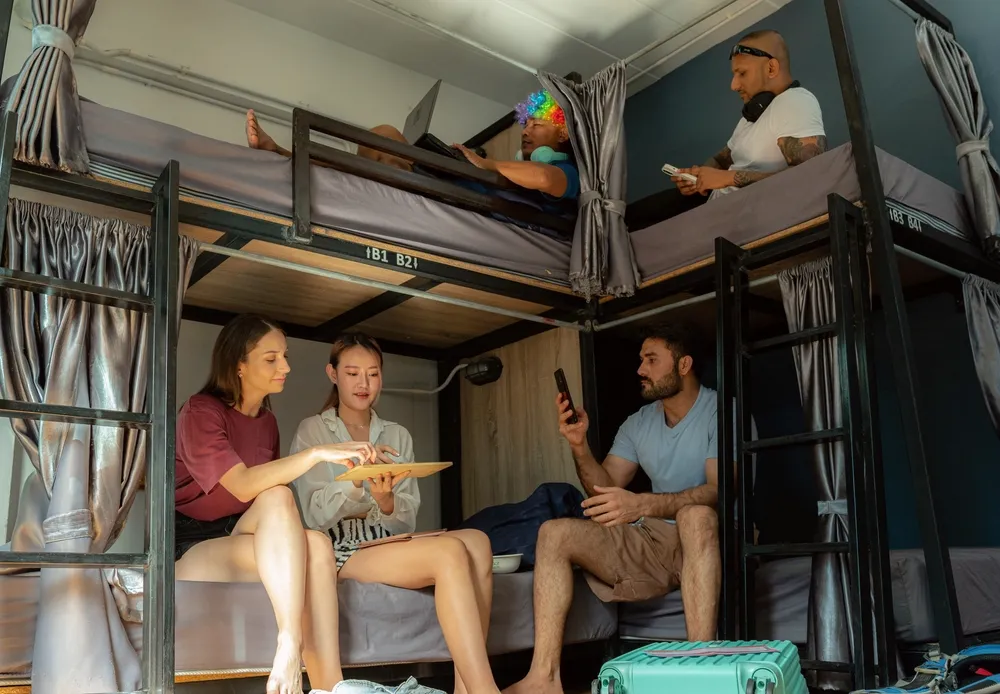
Hostels are where backpacking’s social magic happens, and the etiquette takes about a day to learn. Pack your bag the night before an early checkout, not at 6 a.m. in a rustling symphony of plastic bags. Use your phone torch, not the dorm light, after hours. Keep valuables in the locker (that padlock you packed) and shower shoes on your feet.
Book dorms with 4 to 8 beds when you can; they’re marginally pricier than the 16-bed caverns and dramatically better for sleep. Read recent reviews for the words “social” or “quiet” and pick whichever matches your mood, because both exist and mixing them up ruins someone’s night, possibly yours.
And say yes to the hostel dinner, the pub quiz, the communal cooking night. The friendships formed over shared pasta in a hostel kitchen have outlasted many formed over years at home.
The mindset tips that matter more than gear
Travel slower than your itinerary wants you to. The most common first-trip regret isn’t missing a sight; it’s rushing past the places that deserved three more days. Every travel day costs money, energy and a morning. Fewer stops, longer stays, richer trip.
Leave gaps in the plan. Book the first two nights and know your rough direction, then let the road fill in the rest. The best parts of any backpacking trip are the detours someone recommends over breakfast, and a fully booked itinerary has no room for them.
Say yes more than feels natural. To the invitation, the unfamiliar dish, the town you’d never heard of last week. Your common sense stays switched on, but your default answer changes. That single adjustment is where most of the stories come from.
Learn ten words of the local language. Hello, thank you, please, sorry, how much, delicious. Ten words, learnt on the flight, transform how people treat you everywhere on earth.
Expect a wobble. Somewhere around day four or five, homesickness or doubt tends to visit. It’s chemistry and jet lag more than truth. Call home, eat something familiar, sleep properly, and see how you feel two days later. Almost everyone feels differently two days later.
Quick answers for first-time backpackers
How much money do I need for my first backpacking trip?
For a one-month trip: roughly $1,000 to $1,500 in Southeast Asia, $1,300 to $1,700 in Central America, or $2,500+ in Western Europe, plus flights, insurance and an untouched emergency fund. Verify current prices for your route; these shift year to year.
What size backpack for backpacking abroad?
40 to 45 litres for most people; 50 to 55 if you’re carrying cold-weather gear. Bigger packs mostly carry regret.
Is backpacking safe for beginners?
Statistically, yes. Millions do it every year without incident. The real risks are mundane: traffic, sunburn, dodgy scooter rentals and unlocked lockers, not the dramatic scenarios the news suggests.
Do I need to speak the language?
No. English plus a translation app plus gestures covers the backpacker trail. Ten polite local words cover the rest.
The bag by the door
Preparation matters, and that’s what the last three thousand words were for. But there’s a moment when preparation ends: the bag is packed, the passport’s in the pocket, and the only step left is the one out the door.
Take it. The first trip is never the perfect trip. It’s the one that teaches you how to take all the others, and it starts working on you the moment that small voice in the airport taxi finally goes quiet.